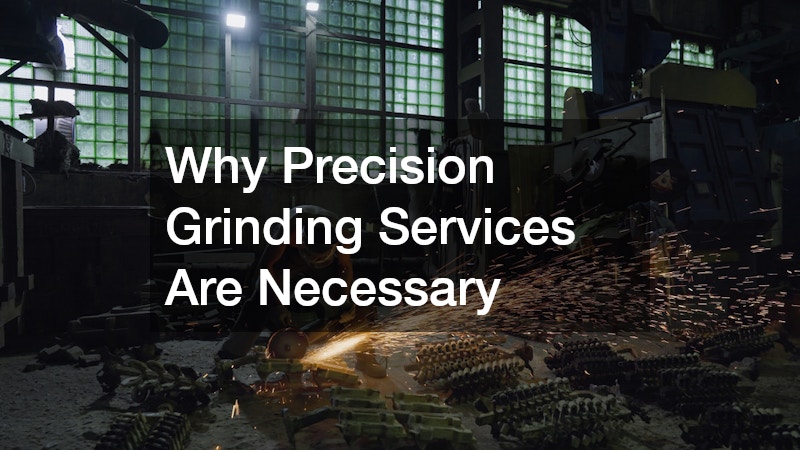
In today’s competitive manufacturing industry, precision and efficiency are crucial for maintaining a competitive edge. One service that plays a critical role in achieving this is precision grinding. This article explores the necessity of precision grinding services, detailing its applications, benefits, and contributions across industries.
What are Precision Grinding Services?
Definition and Overview
Precision grinding is a machining process that removes material from a workpiece with a rotating grinding wheel to achieve exact dimensions and a smooth surface finish. This process is vital for industries where intricate details and strict tolerances are critical to functionality and safety.
By carefully grinding down surfaces, components are shaped to exact specifications, often down to microscopic measurements, ensuring defect-free results.
The process relies on advanced machinery operated by skilled technicians who ensure each component meets high standards. In production environments, the demand for fast, reliable results makes precision grinding even more significant. Technological advancements have enhanced the process’s accuracy and efficiency, making it a cornerstone of modern manufacturing.
Types of Precision Grinding Techniques
Several techniques exist to address different tasks. Cylindrical grinding produces precise diameters on cylindrical parts, essential in automotive and aerospace applications. Internal grinding achieves superior finishes and tolerances on internal surfaces. Surface grinding creates flat surfaces for uniform thickness and precision. When combined, these techniques produce components with exceptional accuracy.
Advancements in computer numerical control (CNC) technology have further improved precision grinding. CNC systems allow automated adjustments during the process, increasing speed, accuracy, and repeatability. As automation and smart systems advance, precision grinding continues to expand its capabilities in manufacturing.
Industries Relying on Precision Grinding
Aerospace, automotive, and medical device sectors heavily rely on precision grinding to meet strict quality standards. In aerospace, minor deviations can lead to catastrophic failures, making precise tolerances essential. Automotive components also require high accuracy for safety and performance.
Medical devices, including surgical tools and implants, demand exceptional precision and regulatory compliance. Precision grinding ensures components function safely and effectively, from durable instruments to personalized implants.
Emerging industries like renewable energy further highlight the importance of precision grinding. High-tolerance parts are critical for efficiency and sustainability, making precision grinding essential for producing reliable, environmentally responsible components.
How Precision Grinding Enhances Manufacturing
Improving Product Quality
Precision grinding improves product quality by achieving high-accuracy finishes, ensuring components fit and function correctly. This reliability is critical in high-tech sectors, where performance and durability are non-negotiable. Reducing defects minimizes waste, streamlines production, and lowers environmental impact. High-quality finishes also support consistent manufacturing for global supply chains, reinforcing customer trust and international standards compliance.
Efficiency and Cost-Effectiveness
By minimizing material removal, precision grinding reduces waste and improves efficiency, leading to cost savings. Streamlined production cycles allow faster throughput and agile response to market demands. Durable parts require fewer replacements, lowering lifecycle costs and enhancing customer satisfaction. These economic benefits extend to both manufacturers and end users, demonstrating the comprehensive value of precision grinding.
Customization and Flexibility
Precision grinding allows for customization to meet specific client requirements, critical in research and development and high-mix, low-volume production. The ability to produce bespoke components supports innovation, facilitates iterative design improvements, and enables rapid adaptation to market needs. This flexibility ensures manufacturers can remain competitive while maintaining high quality.
Challenges and Solutions in Precision Grinding
Technical Challenges
Precision grinding faces technical hurdles such as tool wear, heat generation, and maintaining tolerances. Grinding wheel wear requires regular maintenance, while heat can alter material properties, necessitating advanced cooling and lubrication systems. Maintaining consistent quality over long production runs demands robust process controls, real-time monitoring, and automation to enhance reliability.
Overcoming Skill Barriers
The complexity of precision grinding demands skilled operators. Comprehensive training programs and workforce development cultivate competent specialists. Incorporating computer-aided manufacturing and machine learning reduces reliance on operator expertise, automates repetitive tasks, and enhances process consistency. Industry collaboration and knowledge sharing further support the development of skilled operators for future demands.
Technological Advancements
Technological innovations are improving accuracy and efficiency in precision grinding. Smart sensors, real-time monitoring, and integration with 3D printing refine processes. Advanced abrasive materials, such as cubic boron nitride and diamond, increase tool durability and performance. Automation and artificial intelligence enable predictive maintenance, adaptive control, and customized quality assurance, ensuring precision grinding continues to evolve as a critical manufacturing solution.
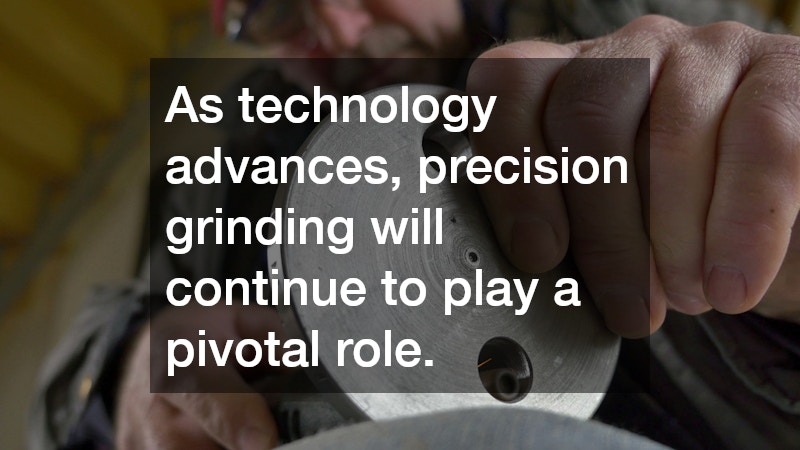
Precision grinding services are indispensable for industries requiring high accuracy and quality. Its diverse techniques enhance product quality, reduce costs, and enable customization and flexibility. As technology advances, precision grinding will continue to play a pivotal role in modern manufacturing, driving efficiency, innovation, and reliability across sectors.